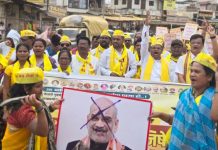
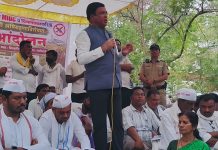
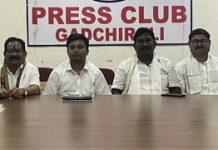
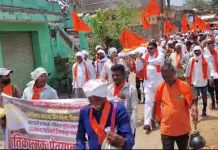
Taking cognizance of the farmers’ agitation that has been underway for the past two days at the district headquarters against the land acquisition process for the proposed Gadchiroli Airport, Minister of State and District Co-Guardian Minister Adv. Ashish Jaiswal visited the protest site as a representative of Chief Minister Devendra Fadnavis. On this occasion, he announced that the ongoing process related to land acquisition for the airport would be temporarily suspended for the time being and assured the protesters that a final decision would be taken after discussions with Chief Minister Devendra Fadnavis.
He also clarified the government’s position regarding the land acquisition process currently underway for Lloyds and JSW under Phase V of the proposed Chamorshi Industrial Estate. According to him, affected citizens and farmers would be granted an extension of 90 days(?) to submit objections and suggestions under the existing land acquisition notification. Consequently, further proceedings would remain on hold during this period. However, since no concrete decision has yet been made, the announcement has raised a fresh set of questions.
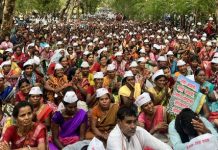
Thousands of farmers had gathered outside the District Collector’s office in opposition to the proposed MIDC project, airport project, and the acquisition of their lands. Braving the scorching heat, they came with their families, determined to fight for their livelihoods, farms, and future. Many even spent the night at the protest site. However, the manner in which the agitation concluded has given rise to several serious concerns.
What exactly did the farmers gain from this movement? Those who participated in the protest to protect their lands, homes, and future have been offered only a temporary suspension of the acquisition process. Is this truly a victory, or merely a delaying tactic? This question now lingers in the minds of many farmers.
In a democratic system, the success of any movement lies in collective decision-making. But in the case of the Gadchiroli agitation, were the majority of the farmers or representatives of the various organizations and political groups supporting the movement consulted before the final decision was taken? If not, then on whose behalf was this decision made? Who authorized a handful of individuals to stamp their approval on the emotions and expectations of thousands of farmers?
A people’s movement belongs to the people; it is not the property of any individual or group. The leaders and activists who spearheaded this farmers’ movement deserve appreciation and best wishes for future efforts. However, it must also be remembered that in many mass movements, the ego of leadership and the desire for publicity often overshadow the core issues. Such a situation must be avoided. If the pain and struggles of farmers are used as a platform to build political images, then the movement ceases to be a struggle for justice and becomes a bargain struck in the name of that struggle.
Perhaps the most alarming aspect is that thousands of farmers came with the hope of a concrete resolution to their problems.
What they seem to have received instead is a carrot of promises and a lollipop of temporary suspension. There has been no official declaration that land acquisition has been canceled, no announcement that the projects have been withdrawn, and no clear indication that the farmers’ demands have been accepted. Then what exactly is being celebrated as a victory?
If fertile agricultural land is being taken away in the name of development, opposing such actions is a legitimate democratic right. More importantly, however, it is the responsibility of leadership to provide proper direction to that resistance and maintain the trust of the farmers. If the leadership itself fails to remain honest with the sentiments of the farmers, the struggle weakens and the task of those in power becomes easier.
Today, many farmers in Gadchiroli are dissatisfied. They believe that their struggle is far from over. In fact, they feel that the real battle is only beginning. Farmers’ issues cannot be resolved through temporary suspensions; they can only be settled through permanent and just decisions.
History bears witness to the fact that temporary assurances do not resolve people’s struggles. A movement succeeds only when the final decision serves the interests of the people and is taken with their consent. Otherwise, the agitation may end, but the discontent remains alive.
Today, the farmers of Gadchiroli stand at a crucial crossroads. They must decide whether to keep the leadership of their struggle in their own hands or continue relying on a few self-proclaimed representatives. After all, the land belongs to the farmers, the future belongs to the farmers, and the struggle is theirs alone.
And so, one question continues to be asked again and again: Was this a victory for the farmers’ struggle, or a bargain made with their trust?
The farmers are now preparing to return to the streets once again. This time, the agitation will not merely be a warning – it will be a real and decisive battle for their rights.
“आता उठवू सारे रान, आता पेटवू सारे रान,
शेतकऱ्यांच्या राज्यासाठी लावू पणाला प्राण !”…
At this moment, these lines from Sane Guruji’s poetry seem especially meaningful, do they not?
– Anil Keshavrao Barsagade
M. +91 9420510239. anil.barsagade@gmail.com